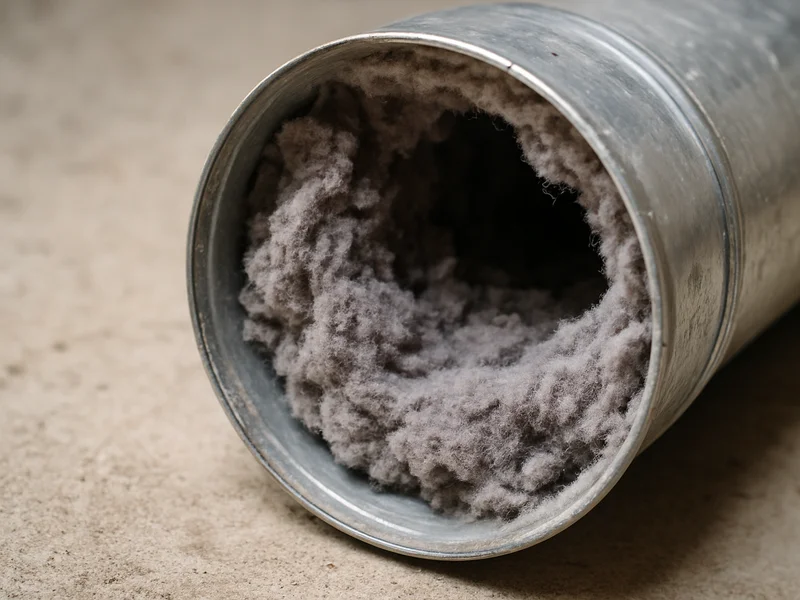
The whole duct run brushed and measured - not the first three feet you can reach by pulling the dryer out.
That is the usual first symptom, long before anything gets dangerous. Tell us the duct length and where it exits and we'll quote it.
Get a Free QuoteLint is not dust. It is fine, dry cellulose fibre packed against warm metal with air moving over it, which is close to a textbook description of tinder. It accumulates fastest at the elbows, at the exterior damper, and anywhere the duct sags into a low spot - all places you cannot see and cannot reach from the laundry room.
We brush the entire run with a rotary head sized to the duct, working from both ends where the routing allows, and we measure airflow at the exterior outlet before and after. The measurement is the point: it turns 'seems better' into a number you can compare next year. If the duct is crushed, disconnected inside a wall, or run in flexible foil where it should be rigid metal, we tell you that rather than cleaning it and calling the job done.
| Situation | Typical price |
|---|---|
| Standard run under 15 feet, exterior wall exit | $120 - $160 |
| Long run, basement routing or roof termination | $160 - $220 |
| Added to a chimney sweep on the same visit | $85 - $110 |
| Nesting or heavy blockage removal | +$40 - $80 |
| Transition hose replaced with rigid metal | quoted on findings |
Cold outside air makes a dryer work harder. Every cycle pulls in air that has to be heated from a Montana winter starting point rather than a mild one, so run times are longer, and longer run times mean more lint moved through the duct per load. That alone shifts the sensible cleaning interval from the manufacturer's cheerful 'annually' toward something closer to every nine months for a household doing serious laundry volume.
The bigger local factor is routing. Butte's older housing was not built with laundry rooms; the dryer usually ended up in a basement, which means a long horizontal run to reach an exterior wall, often with two or three elbows and a section that sags between joists. Every elbow is a collection point. Ranch homes around Deer Lodge have the opposite problem - shorter runs, but frequently terminating through a roof or a soffit where the exterior hood is out of sight and out of mind for years at a time.
The exterior damper is where most of it becomes visible. When lint mats the flap open, it stops being a one-way valve: cold air comes back down the duct, moisture condenses inside it, and damp lint packs harder than dry. That is the state we find most often on a first visit, and it is why we finish at the outside wall rather than starting and stopping at the dryer.
Once a year for a typical household, and closer to every nine months if you run several loads a day or the duct run is long. If drying time has crept up to two cycles for a normal load, it is already overdue regardless of the calendar.
Both. Clogged dryer vents are a recognised residential ignition source, which is why the International Mechanical Code requires ducts to be rigid metal and independently vented outside. Most of the time the practical effect is a slow dryer and a high power bill; occasionally it is worse than that.
Yes, and roof terminations are the ones most worth doing, because nobody ever looks at them. They carry a slightly higher price because of the access, and we quote it before we start.
We pull the dryer out, clear the transition hose and clean the lint that has collected behind and under it. Opening the cabinet to clean the internal blower housing is appliance repair work and we will tell you if we think it is warranted.
Most vents we clear have never been done. Call or send the form for a firm price.